
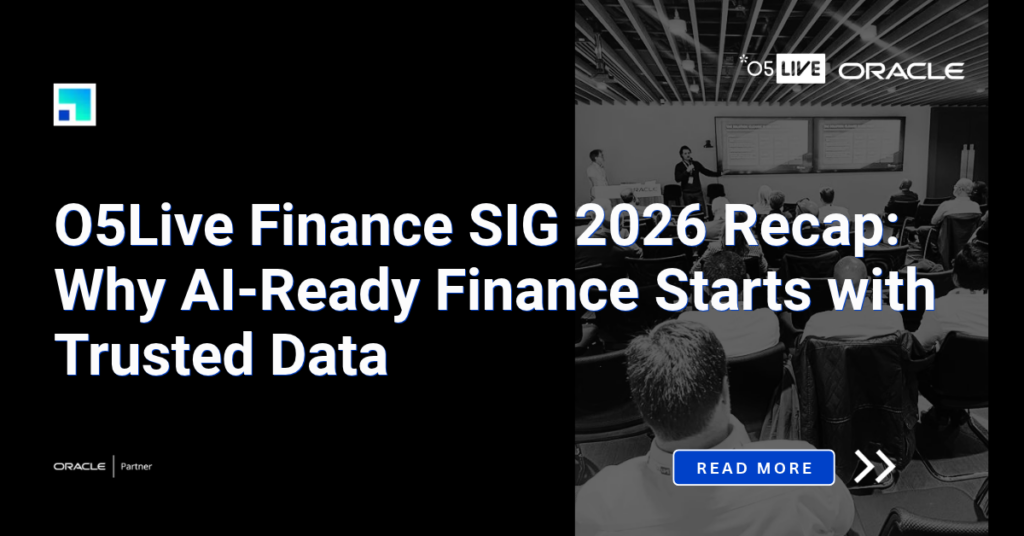
On October 8, 2026, finance and Oracle ERP professionals gathered at Oracle’s London City office for the O5Live Oracle Finance Special Interest Group (SIG). The Oracle CSS team and O5Live hosted the one-day event under the theme “Close Faster, Decide Smarter: AI and Automation in Finance Transformation.”
Six sessions covered AI strategy, indirect tax, finance reporting, release adoption, procure-to-pay (P2P) and ERP data management. Speakers came from Oracle, Innovate Tax, SplashBI, FudgeLearn, Arcivate, and More4apps. Every speaker described a different AI capability, but each one depended on the same thing: trusted, well-governed ERP data.
The More4apps session focused on building that foundation. This recap covers the More4apps presentation, followed by highlights from the other sessions.
Fixing data before it reaches Oracle: the More4apps session
Josh Mason, Account Manager, and Andrew Gooch, Product Specialist, presented the More4apps session, “Driving Data Accuracy and Efficiency in Oracle Fusion Cloud ERP.” This session focused on how finance and operations teams can clean, validate, and load ERP data at scale.
AI amplifies messy data. It doesn’t fix it.
The session placed More4apps alongside AI tools rather than in competition with them. Tools such as Microsoft Copilot or Claude in Excel can help clean, organize, and format data. Oracle AI agents are mostly built for insights, not for mass data changes. Human review also remains critical for ERP data.
More4apps fills the gap between those two. Its Excel-based tools validate data against the live Oracle instance before upload, so errors are caught before they reach the ERP. The session summed up this division of labor in one line: “Use AI to prepare. Use us to validate and load.”
Case study: Imperial College London, 25 years of Oracle data
Before moving to Oracle Fusion Cloud, Imperial College London assessed its Oracle E-Business Suite (EBS) data:
| Data | What Imperial found |
| Suppliers | 250,000 active, of which 170,000 had not been used in 2 years |
| Purchase orders | 100,000 open, some dating back to 1999 |
| Customers | 80,000 active records |
| GL account combinations | 1 million active |
The session explained why this matters: “Fusion only delivers if the data going in is right. Anything left uncleaned is migrated with it, and reporting, audit readiness, and AI inherit the mess.”
Imperial cleansed and enriched its data in EBS before migrating. It only moved data that was current, relevant, necessary, and of good quality. Using bulk More4apps tools in place of error-prone manual loading, the team:
- Closed 70,000 purchase orders
- Deactivated 30,000 customers
- Added DUNS numbers to 12,000 customer accounts
- Added 7,000 supplier addresses
- Applied 4,500 receipts
- Reclassified 4,000 suppliers as SMEs
Four steps to prepare your data
- Start early. Treat data cleansing as its own workstream, not a late-stage task.
- Cleanse in your current system. Fix, enrich, and retire records before migration.
- Apply a clear filter. Is the data current, relevant, necessary, and of good quality? If not, leave it behind.
- Size the problem and tool up. Profile suppliers, open POs, receipts, and customers, then replace manual loading with bulk tools.
The session closed on a point that came up again in other sessions throughout the day: “Data is the business’s responsibility, not just IT’s.” More4apps tools are Excel-based, so business users can download, validate, correct and upload Oracle data themselves. They don’t need to raise an IT ticket for each change.
What did the other sessions cover?
Partners from Oracle, Innovate Tax, SplashBI, Arcivate, and FudgeLearn each approached AI in finance from a different angle. One idea kept coming up: AI depends on the quality of the data underneath it.
Oracle: AI needs to see, understand and act. Dominic Stewart, Senior Director of Solution Engineering at Oracle, opened the day. He noted that leaders have moved from “show me AI” to “show me measurable business value.” He also pointed out that AI stalls when enterprise data is fragmented across applications, databases and files.
Innovate Tax: don’t put AI over unstructured data. Andrew Bohnet, Global Solutions Architect, described tax as “the only team legally responsible for reporting data it has no control over.” In his view, AI adds value only when it sits on structured, controlled data.
SplashBI: “almost right” is wrong. Simon Beresford and Marc McGurk argued that finance AI “must be deterministic, not creative,” with answers that are governed and auditable.
Arcivate: clean data doesn’t stay clean. Jason Howard and Duncan Coyle showed how supplier records drift and duplicates build up over time. Their point was that master data needs ongoing monitoring.
FudgeLearn and Oracle CSS: readiness is continuous. Johnny Needham, Tony Cook and Rachael Griffiths covered how to prepare users for each quarterly Oracle Fusion release. The same discipline applies to data, which keeps changing as Oracle does.
Key takeaways for Oracle finance teams
- AI value depends on data quality. Oracle, Innovate Tax, SplashBI, and More4apps each made the point that AI cannot produce reliable results from fragmented or unstructured data.
- Finance AI must be deterministic and auditable. SplashBI, Oracle, and Innovate Tax each stressed that numbers need to be explainable, governed, and traceable back to source records.
- Data quality decays without ongoing governance. Supplier records, open POs, and tax data need regular monitoring and cleanup.
- The business owns the data. Finance, AP, and tax teams need tools that let them maintain data directly, without relying on IT for every change.
- Clean data before you migrate or automate. Imperial College London’s EBS cleanup shows how much legacy data can be retired or corrected before it reaches Oracle Fusion Cloud ERP.
Get your Oracle data ready for AI
Whether you’re running Oracle EBS, migrating to Oracle Fusion Cloud ERP, or preparing for AI, More4apps helps you get your data right at every stage. Explore the ERP Cloud Toolbox or book a demo to see how your team can clean, validate, and load Oracle data in Excel.
Thanks to O5Live, the Oracle CSS team, and fellow partners Innovate Tax, SplashBI, FudgeLearn, and Arcivate for a valuable day of discussion.
What was the O5Live Oracle Finance SIG?
It was a one-day Special Interest Group event held on October 8, 2026, at Oracle’s London City office. It was hosted by the Oracle CSS team and O5Live and focused on AI and automation in Oracle finance transformation.
Why is data quality important for AI in Oracle ERP?
AI tools and agents rely on the data in your ERP. Duplicate suppliers, outdated records, and inconsistent data produce unreliable outputs. As More4apps put it at the event, AI amplifies messy source data rather than fixing it.
How can finance teams prepare Oracle data for AI?
Start cleansing early, fix records in your current system, and keep only data that is current, relevant, necessary, and of good quality. Then use bulk tools that validate against Oracle before upload to correct data at scale.
Can AI tools like Copilot or Claude load data into Oracle?
They can help clean and format data in Excel. However, validating and loading that data into Oracle at scale still needs dedicated tools that keep up with Oracle’s quarterly updates and support human review.
How does More4apps help with AI readiness?
More4apps provides Excel-based tools for Oracle E-Business Suite and Oracle Fusion Cloud ERP. Business users can download, validate, correct, and upload data from a single spreadsheet, so errors are caught before they reach Oracle.